The Home Birth Debate
Mamas-to-be are ditching the hospital in favor of giving birth at home
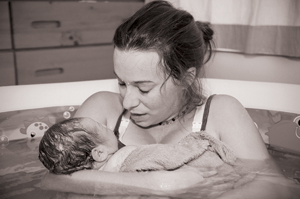
Most women who opt for home births, like this Charlotte woman pictured with her newborn, have low-risk pregnancies.
The bedroom used to be reserved just for the baby-making part. But nowadays, the bedroom is being used more frequently for baby birthing. According to the Centers for Disease Control, the number of women laboring and giving birth at home has steadily gone up every year for the past ten years. It’s no surprise that the home-birth trend has taken off; Gisele Bündchen’s and Ricki Lake’s recent home births were highly publicized. (Lake even made a documentary, which critics are praising, about her experience.)
Jocelyn Rodriguez gave birth to her daughter Chloe in her Concord home. “My mother had three home births and my sister had one, too, so I was used to natural births,” says Rodriguez. “I knew I didn’t want to fight my way through a natural birth in the hospital. I didn’t want all the tests, the fetal monitoring.” So Rodriguez set up an inflatable pool in her game room in anticipation of her water breaking and hired a midwife to oversee her labor.
Hallie Lyon, a certified nurse midwife who works at Charlotte OB/GYN, one of four practices in town that has a midwife on staff, says she understands why some women want a more natural approach when giving birth, and adds that hospitals are OK with that. “I think women want to experience natural childbirth to let their bodies do what they feel like they were naturally made to do,” she says. “But they feel like in the hospital setting they won’t be supported—that they’ll be strapped down to monitors.”
But hospitals provide alternative birthing options for moms-to-be, she adds. “We’ve made such great strides to have things for women. We even have Jacuzzi tubs,” says Lyons, who advocates hospital births over home births due to the potential risk of complications that may arise during labor. “If something goes wrong at home, the mother and baby first have to get to the hospital instead of already being there.”
Sarah Bemis-Coate gave birth to her daughter in her own bed six years ago and says most women who opt for home births have a low-risk pregnancy. Bemis-Coate knew she wanted a home birth after studying different cultures in an anthropology class in college. She went to midwifery school and now runs Charlotte Natural Birth Group. “We have all kinds of people … from liberal hippies to very conservative religious people who have joined the birth group,” she says.
“You don’t have to look for it in anthropology textbooks anymore. It’s gone mainstream!”


Email
Print


We invite your responses and discussion. Please refrain from personal attacks, profanity, commercial promotion, or non sequiturs.
Reader Comments:
I'm sorry, but as a doula here in Charlotte, I have not found what Hallie Lyons is saying to be true. Sure, they have tubs(speaking of CMC main where Ms. Lyons works), but they also have many restrictions on getting in them......restrictions that are not based on evidence based medicine, so you may not get to use them for your labor if your membranes have already ruptured or if you are a VBAC who has to be monitored continuously. If it were truly as easy as Ms. Lyons makes it seem to have a natural birth in the hospital, then I wouldn't have a job. Instead, I am busy enough to have had to refer multiple potential clients to other doulas.
Also, quite a few of Ms. Lyon's fellow CNM's would disagree with her on the safety and benefit of homebirth for low risk women. There are CNM's in NC who offer both homebirth and birth center birth as an option for their clients. So Ms. Lyon's opinion on where a woman is safest giving birth is simply that....opinion, but note that it is opinion that is not based in fact. Multiple studies have proven that homebirth/birth center for low risk women is as safe as hospital birth. And people are educating themselves now and realizing that CNMs and Certified Professional Midwives(CPMs) alike are well trained to handle complications in the out of hospital setting.
I will say, in my experience as a doula who has attended over 100 births, that there are some hospitals who have made great strides to be more natural birth friendly. Davis Hospital in Statesville has welcomed a natural minded MD and Midwife practice that is reforming their practices to be more mother/baby friendly. CMC-Pineville has impressed me greatly in my last few births there with their endeavors to honor mothers birth plans and keep mom and baby together in the hours after birth. However, for those who choose homebirth and birth center birth, even these places will seem intrusive and medicalized. There just really isn't a comparison.
Despite what those against homebirth might claim, there is not one study done here in the US, that proves that homebirth is dangerous.. not ONE. However, every study that has ever been done on homebirth has shown many, many benefits to mother and baby, including- less chance of tearing, laceration, PPH in mothers and less birth trauma in homebirth babies. For more information on the truth about homebirth and the lies that those against homebirth mean to spread, please check out my blog:http://theskepticalmother.blogspot.com/2011/09/truth-about-homebirth.html
Here, I will try it one more time! http://theskepticalmother.blogspot.com/2011/09/truth-about-homebirth.html
Don't expect results to be any better with legal and/or licensed midwives. Oregon has been down that road and now, almost 20 years later, we are finding how difficult it is to repair a situation that has spiraled out of control. Direct entry midwives have stacked their "regulatory" board with reps from a national advocacy group: http://oregonmidwifereviews.blogspot.com/2011/09/what-do-leaders-of-oregon-direct-entry.html They have rolled back sensible restrictions on their scope of practice until such regulation is all but nonexistent. Midwives with multiple preventable infant deaths--like Jennifer Gallardo--aren't just still in practice, they are LEADERS in the state's midwifery community, owning birth centers grossing in the million+ dollar range yearly. And even on the rare occassion when an injured mother is able to find a lawyer who will bring suit against the nearly untouchable midwives, the midwife can just go back into business unlicensed--or, in the case of the woman who gave a new mother flesh eating bacteria while repairing her tears without gloves, she can just change her name: http://oregonmidwifereviews.blogspot.com/2011/09/wherever-you-go-there-you-are.html
Dr. Amy, for every death that you find that has happened at home, so can I find an unnecessary death that happened in the hospital. As a skeptic, you should know that anecdotes do not prove anything. It is always a tragedy when a baby dies, whether preventable or not, however, trying to scare women to give birth in the hospital does not mean that babies will not die preventable deaths! I am also aware that at least two of the homebirth deaths you blogged about this year were not due to homebirths! One was a stillbirth and the autopsy confirmed this and the second took place in a different country with an OB present at a birth center. You have no evidence to prove homebirth is dangerous here in the US. Can you name one study that proves this?? And, once again, if you bring up some australian study, I will bring up the study done in canada that proves homebirth is actually safer than the hospital. If you bring up the CDC dataset, which is only two years of raw data- which is not scientific evidence btw, please inform the readers that it includes high risk women and lay midwives. In addition to that,if we are going to actually use the CDC numbers as though they are scientific evidence, you may also want to inform people that homebirth that includes high risk women is safer than babies that are born by elective c-section when there isn't a need.( 1.2/1000 neonatal deaths for homebirth and 1.77/1000 for elective c-sections). It is as safe when an repeat elective c-section is performed ( 1.2/1000 neonatal deaths vs. 1/1000 neonatal deaths). And safer than VBACs done in the hospital ( 1.2/1000 v 2/1000).
There are plenty of studies that show homebirth in the US has three times the death rate of hospital births. While studies in some countries have found homebirth to be reasonably safe, those countries have well-trained midwives with strict protocols to follow as to who can birth at home, i.e., only truly low risk women give birth at home and the midwives are skilled enough to realize how to differentiate between low and higher risk pregnancies, as well as having the ability to recognize when they need to transfer. Unfortunately, here in the US that just isn't true. We have two classes of midwives: the well-educated -- minimum of a master's degree -- and highly skilled nurse-midwives; and the CPMs, who have created a certification that allows dangerously ill-trained women to call themselves midwives and gives the illusion of legitimacy. It isn't even required that they've graduated from high school.
Apparently you have no idea how math works, Sammy. We're talking RATES here, not numbers. 99% of births in the United States happen in the hospital. If homebirth and hospital birth were of equal safety, you would not expect the same number of babies to die in both. As it is, babies born out of the hospital with midwives other than CNMs die at three times the RATE of babies born in the hospital.
Keepbabiessafe, EXACTLY! Anecdotes are meaningless. Please provide peer reviewed studies that are not riddled with flaws if you are going to claim homebirth is dangerous.
Sammy, can you please provide data showing equivalant hospital deaths, please? I would be interested in reading that. Thanks.
I checked out the skeptical mother, but found a real lack of evidence. It seems more like a confused rant against some people that the poster doesn't get along with. If this is what passes for defense of homebirthers, I might suggest they find another advocate. Maybe one with some credentials.